


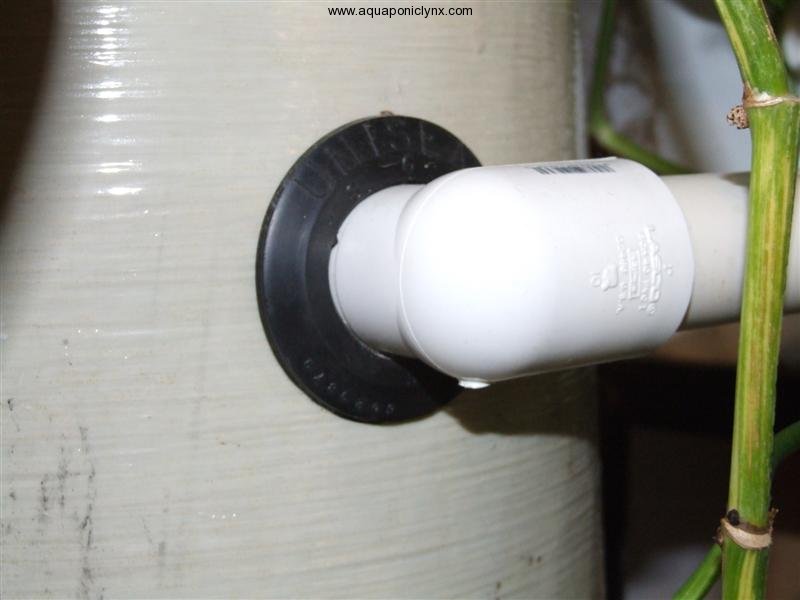
Uniseal installed
Plumbing through tank walls is made much easier and less expensive using a Uniseal®. Unlike bulkhead fittings a Uniseals can handle slight irregularities or curvatures without leaking. With a sturdy backing, a Uniseal® can even be plumbed through liner.
Bulkhead fittings often have limited connection options and force the use of extra threaded fittings to connect the pipes. Bulkhead fittings usually cost more than Uniseals.
Instructions for installing Uniseals
- Cut hole to the proper size for the Uniseal you are using.
- Insure that the hole is clean cut with no sharp edges. Irregularities could cause poor sealing and ultimate leakage.
- Insert the Uniseal into the hole with the wide side facing the pipe to be inserted.
- Make certain that the pipe end to be inserted is clean cut. sand the edges so that there are no sharp points.
- Using rubbing alcohol or slimy water, lubricate the outside of the pipe end to be inserted (the manufacturer recommends detergent and even Aquatic Eco systems says windex but both these could be bad for the fish so I usually just use water or rubbing alcohol since it will evaporate,) then push the pipe through the Uniseal from the large flange side. The co-efficient of friction of the rubber holds the pipe tightly in place.
I have found that using a T on the end of the pipe being pushed through provides a good handle to push against since pushing the pipe through a Uniseal® is the only difficult part about the whole procedure. Make sure before deciding to use a Uniseal® that you will have the space and angle/leverage to push the pipe though and that the hole will have enough clear space around for the flange of the Uniseal® to seat properly (don’t drill the hole too tightly into a corner.)
A Uniseal® can even be plumbed into a pipe, but the pipe having the Uniseal® hole cut in it must be enough larger than the Uniseal® being installed that it will still seal properly.
Shipping FYI. The paypal shipping calculator is not flexible enough for the variety of products on my site. If paypal over charges on shipping on the uniseals, I will refund the difference since uniseals are small and I can often ship them for less than the estimate based on weight would suggest.
If you are interested in buying value packs (appropriate numbers of uniseals to fit in a flat rate envelope for shipping) please check out the Uniseal Value Pack Page
Sizes listed are for the “Nominal” USA PVC pipe size. For more info on PVC pipe sizes see Pipe Size Chart
[eshop_list_cat_tags type=”category_name” find=”Uniseals” price=”yes” records=”30″ panels=”yes” form=”no”]
Pipe sizes listed are the “Nominal” pipe sizes that match the Schedule 40 PVC Outside Diameter here in the USA where the Uniseals are made. The “Nominal” size does not indicate the outside diameter of the pipe. Pipe sizes are NOT the same world wide. While it seems the pipe sizes in the USA and Australia are compatible some parts of Europe are NOT and I do not know where else. Please do some research into pipe sizes before ordering. I do not refund the shipping or pay for the return shipping on uniseals since it normally costs more to ship them than it costs for the parts themselves.